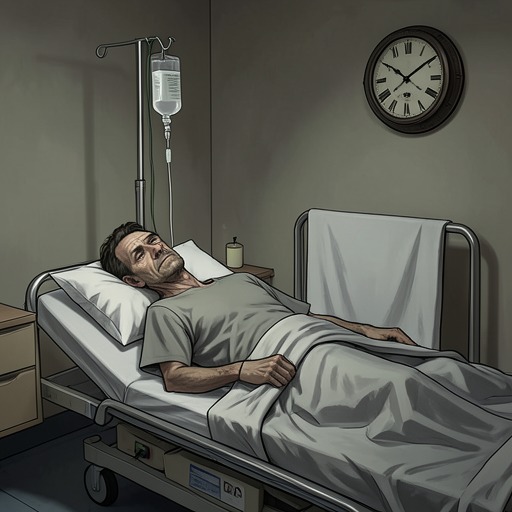
Edison’s morbid obesity
Big BrotherEdison’s morbid obesity is a central, changing condition in the narrative: a measurable health risk that becomes a source of social judgment, a focus of family intervention, and a lived experience tied to food, work, and self-worth. The story gives it medical figures and diagnoses, but refuses to let those figures stand as a complete account of Edison. His own explanations connect weight gain to professional rejection and distress; his sister’s concern turns the condition into a reason for action, while their restrictive plan reveals that the attempt to control it can also become hazardous.
Identity and Medical Assessment
The narrative’s approach to Edison’s obesity is uneasy about medical labels even as it relies on medical evidence. When a child asks whether Edison is sick, Pandora answers that, according to current thinking, obesity is an illness, while privately questioning what is gained by applying that label. The exchange sets up a continuing tension: naming a condition may make intervention possible, but a diagnosis does not by itself explain Edison’s life or settle how others should treat him.
That tension becomes concrete at a medical appointment. Dr. Corcoran tells Edison he is pre-diabetic, has elevated blood pressure, and has a body-mass index above fifty-five, associated with significantly increased risk for most cancers. He also notes fluid retention in Edison’s extremities, reduced lung capacity, and the likelihood of emphysema if he continues smoking. The list translates body size into multiple health concerns, while Corcoran’s flat delivery makes the assessment feel routine rather than consoling.
When Pandora asks whether Edison is healthy enough for a severely restricted diet, Corcoran says probably, adding that medication can lower the blood pressure and that Edison’s heart is in better condition than might be expected, though cardiovascular disease remains a serious risk. The medical appointment therefore does not simply authorize weight loss: it records a mixture of immediate concerns, future dangers, and limited reassurance. Pandora proposes beginning at five to six hundred calories a day, with a possible later increase to eight hundred and then twelve hundred. Edison does not initially seem to grasp how little that means; Pandora compares the starting amount to two-thirds of a Cinnabon.
The weighing makes the scale’s authority unmistakable. With Edison’s permission, Corcoran reports a weight of 386 pounds, including his boxers, and Pandora immediately calculates the distance between that figure and her chosen target of 163 pounds: 223 pounds to lose. Her calculations turn the ambition into a daily deficit and an estimated timeline. Yet the numbers are not neutral in the narrative. They enable planning, but they also make the body appear as a problem to be quantified and corrected.
Causes, Work, and Stigma
Edison describes weight gain as a gradual shift in how he saw himself. He had once been a high-school track star and looked good, he says; after he became somewhat fat, another serving seemed less consequential. A lean body had felt like an investment to protect, whereas increasing size seemed to leave him with nothing further to lose. His account links eating not to one cause but to appetite, anger, boredom, and the erosion of reasons to restrain himself.
Professional rejection deepened that pattern. As he became larger, younger musicians saw him as damaging their image, and bands with which he had played for years began listing a different piano player in the Village Voice. Edison says that this made him eat more: food passed the time, answered hunger, and accompanied his anger. His story gives the condition a social history as well as a personal one: discrimination and exclusion do not account for every choice, but they help explain the circumstances in which eating became more entrenched.
He also recalls being blamed disproportionately for food at a Long Island wedding. The band was expected to eat a plate in the kitchen rather than take food from the buffet, but no one had clearly told them so. Edison took shrimp, lobster, and roast beef between sets; afterward, the couple deducted two hundred dollars from the band’s pay, and the band passed the shortfall on to him. He disputes that he ate two hundred dollars’ worth of food and observes that people already assumed, from his appearance, that he had consumed far more than he had. The incident joins economic penalty to weight stigma: his size shapes the accusation before the amount of food is established.
That stigma is also present in the family home. After damage to Fletcher’s Boomerang chair becomes a point of conflict, Edison objects to being treated as though his weight made him contemptible. He distinguishes description from verdict: he knows he is fat, but says that Fletcher’s manner makes it sound like a judgment on his whole character. Edison insists that overeating is not equivalent to harming others and that eating a doughnut does not, by itself, injure Fletcher. The exchange does not erase the health risks or the conflict over the chair; it shows how condemnation of a body can turn a specific dispute into a sweeping moral accusation.
Family Intervention and Restriction
Pandora’s response grows from both affection and fear. She tells Edison that whatever lies behind his eating—whether it compensates for, helps him forget, or hides something—cannot continue indefinitely. When he says that perhaps he does not want to continue, she hopes he means he wants to stop eating himself toward death, but recognizes the more worrying possibility that his overconsumption is itself purposive. The exchange marks the limits of what she can know about his intentions even as it clarifies the danger she perceives.
Her concern becomes explicitly medical when she contrasts his present condition with his body at seventeen and warns that he is placing himself at risk of diabetes, stroke, high blood pressure, and heart disease. She also points to sleep apnea, which he already has and which is related to his weight. The shift from sibling concern to a list of possible illnesses reflects the story’s recurring interdependence of family responsibility and medical language: Pandora uses clinical risks to make an intimate plea actionable.
The restrictive diet initially seems to offer an answer. In the first days, however, Pandora describes hunger as persistent and time as heavy; the effort feels arbitrary and pointless in the absence of immediate results. She fears Fletcher may be right that they will not last even a week. Pride and affection help her persist, along with the remembered warning from Dr. Corcoran that he has no old, fat patients. The program is therefore sustained by more than a calculation of calories: it draws on loyalty, fear of loss, and Pandora’s reluctance to abandon her brother.
For a time, the siblings experience the diet as a shared source of energy and superiority. Edison becomes less resentful and reports having more energy than when he was eating heavily, though he will not equate the elevated feeling associated with ketosis with heroin. Their walks make exercise a way to pass the time; they take pride in moving past fast-food restaurants without buying food and treat their limited routine as a special power. The confidence is real within the account, but it is fragile. A regimen that turns abstinence into status can make ordinary food seem like a moral test rather than a practical part of eating.
Strain and the Limits of the Plan
The narrative does not present restriction as a straightforward cure. Pandora’s account of the first months includes black days and irritability, and the longer period on liquid meals brings signs of physical and functional decline in Edison. As he approaches six months on four envelopes of protein powder a day, his earlier robustness has ebbed. He is shorter of breath, his hands tremble at the piano, and his concentration falters enough that he sometimes sews seams with the finished side of the fabric facing out at work.
Those changes alter the meaning of the weight-loss plan. What had appeared to promise greater health and control now has to be judged against weakness and impaired concentration. Pandora recognizes that continuing the all-liquid diet may be out of the question, but still hesitates over how to change course. Her decision to invite Edison on a bike ride is partly an attempt to show that the regimen cannot go on unchanged; it is also entangled with her wish to spend a sunny Sunday with him and her effort to preserve peace with Fletcher. The plan’s limits thus emerge not in abstraction but through the practical choices of a family negotiating health, marriage, and care.
The book’s account holds together two dangers without making them equivalent: Edison’s severe obesity carries substantial medical risks, and the extreme restriction adopted in response produces its own warning signs. Numbers and diagnoses give Pandora grounds for intervention, but cannot settle what sustainable care requires. In that gap between the scale’s precision and the family’s uncertain judgment, Edison’s obesity remains both a bodily condition and a contested social meaning—one that calls for attention without reducing him to either a measurement or a moral verdict.